Looks like science to me…
The new whiteboard tabletops in the lab seem to be working well for Jack – and it looks like he know’s what he’s doing…
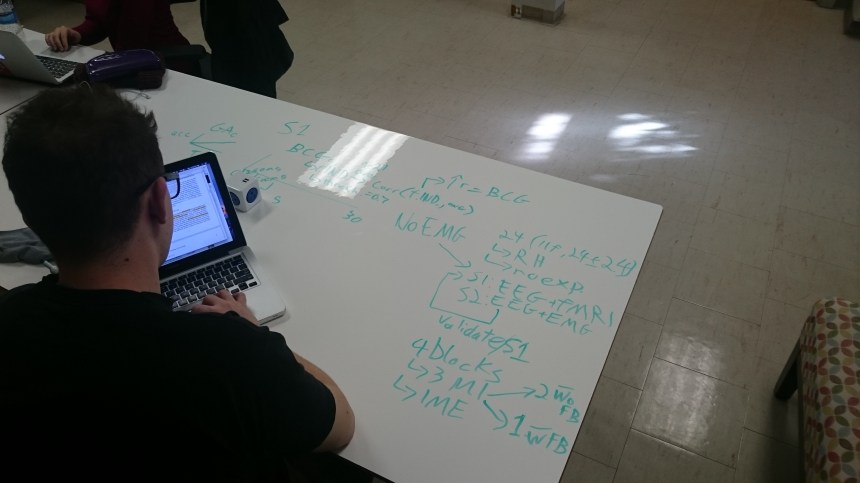

The new whiteboard tabletops in the lab seem to be working well for Jack – and it looks like he know’s what he’s doing…
New research from the lab contributes to our understanding of how learning through motor imagery occurs. The study, co-authored by PhD students Sarah Kraeutner and Tony Ingram, shows that inhibition of motor related areas in the brain do not impair the ability to learn a skill through motor imagery-based practice. You can check out the study here.
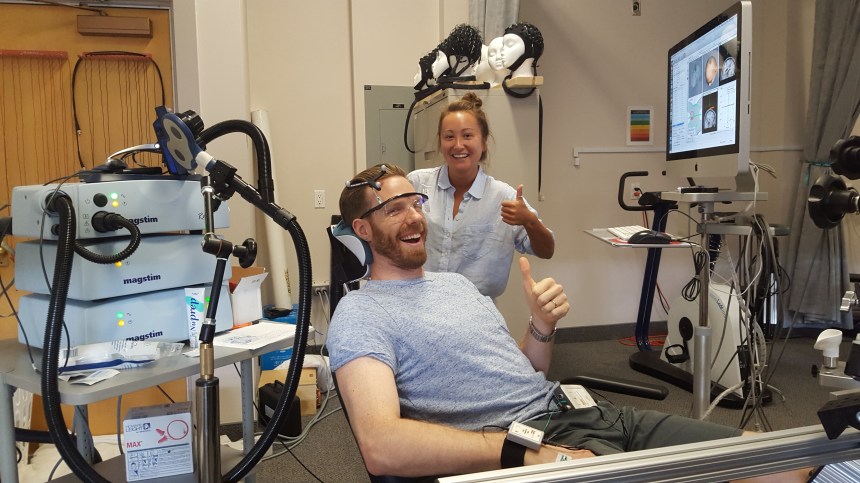
PhD students Tony and Sarah demonstrate the joy of rTMS…
The inaugural RIO (Research in Imagery & Observation) newsletter is hot off the presses. The newsletter highlights research from several of the leading research groups in imagery and observation research, including an update from our lab related to our work on assessing imagery ability. You can check out the newsletter here.

Recruitment is now underway for PhD student Tony Ingram’s first project. Tony has developed a novel task to examine learning of complex motor tasks. This series of projects will use connectivity analysis of functional neuroimaging data to examine how different brain regions interact as we learn, as well as using non-invasive brain stimulation to investigate how learning can be modified. Good luck Tony!

Members of the lab travelled to Quebec City this past week to attend Canadian Stroke Congress. Highlights of the congress included in-depth discussion of recent clinical trials in stroke rehabilitation (the AVERT trial among others), debating the effectiveness of physical rehabilitation (of course its effective!), and emerging treatments to optimize rehabilitation including pharmacological interventions and brain stimulation.
Lab members Sarah Kraeutner and Hawazin Khan presented their work on screening for imagery ability and exercise effects on brain excitability. Overall a great congress, and wonderful to see such a strong contingent from Atlantic Canada! Next years Congress is in Calgary – looking forward to it already!


The lab’s work on expert imagery and brain activity was recently featured on CTV News ‘Live at 5 Housecalls’ segment. This work, led by PhD student Sarah Kraeutner, looks at how brain activity underlying motor imagery changes based on how familiar a person is with the task being imagined. For her study, Sarah recruits varsity athletes from Dalhousie’s mens and women’s basketball and volleyball teams. A big thanks to all the participants in the study. You can check out the CTV interview here.
 .
.
Recruitment is underway for PhD student Sarah Kraeutner’s study on how brain activity differs between experts and novices when performing motor imagery. For this project, Sarah will scan the brains of varsity and novice athletes while they imagine common and sport-specific skills. Results of the study will tell us more about the role of familiarity and prior experience on imagery ability and brain activity.
PhD student Sarah Kraeutner along with Lab Director Shaun Boe have secured funding from the Brain Repair Centre to create an application for screening of motor imagery ability. The ‘app’, to be developed in partnership with Freshworks Studio, will allow for rapid and objective screening of MI ability on iOS (Apple) and Android based tablets and smartphones. Stay tuned for the launch of a prototype!
Sarah’s recent article related to motor imagery and learning has been featured in PeePs–Particularly Exciting Experiments in Psychology— an online review of the American Psychological Association.
This research study shows that learning a new motor skill simply by imagining it can be as effective as actually practising it. Knowing more about how motor imagery helps us acquire new skills is important for people who can’t physically practice, such as injured athletes or people who have lost the ability to move following a stroke. Read the review here.

Lab Director Shaun Boe, along with Tim Bardouille and Matt MacLellan from BIOTIC, have received $40K to support the commercial development of an EEG-based headset for providing neurofeedback during motor imagery. The feedback provided through the headset will guide patients while performing motor imagery, improving the effectiveness of imagery in rehabilitation with the goal of leading to better recovery. This Early Stage Commercialization Funding (ESCF) is through Innovacorp, Nova Scotia’s early stage venture capital organization.
 Official site of the Laboratory for Brain Recovery and Function